Select Page

Whatever their size or type, all skippers have a responsibility to avoid collisions with other boats at sea.  It is important for all boat skippers to know the give-way hierarchy at sea to help avoid accidents. But how similar are the rules of the road on land and at sea?

On land, road users have signs to show them the way and warn them of hazards they are approaching.  They avoid collisions with others by following the road rules.  They use light and sound signals to indicate what their intentions are. 

Broadly speaking, all this happens at sea too.  There are navigation marks which act like road signs; there are road rules to prevent collisions and there are sound and light signals to tell others of a vessel’s intentions.  In addition there are some extra factors to get to grips with:

  • As there are no roads on the water, boats tend to move around in all directions. 
  • There are more diverse shapes and sizes of vessels on the water than there are vehicles on land.
  • There is a give way hierarchy between the types of vessel, which needs to be followed by all boat users.
  • Vessels display lights at night to tell others which direction they are moving in and what type and size of vessel they are.
  • Vessels display shapes during the day to tell others what type of vessel they are and certain activities which they may be involved in. 
  • There are navigation marks which identify safe water channels and hazards to be avoided.
  • There are light beacons which guide vessels safely towards land and into harbour at night.

Learn all of the nautical ColRegs Rules of the Road for power boating and sailing, in our comprehensive reference app, which includes a quiz to test yourself!

The give way hierarchy

If you are in charge of a boat you need to know what to do in a potentially dangerous close quarters situation and act accordingly.  It is important to know the ‘who gives way to whom’ hierarchy and this should be learnt by all boat operators.

Sailing boat hierarchy

Port tack gives way to starboard tack.

If on the same tack, the windward boat gives way.

If it is unclear to a sailing boat on port tack which tack another sailing boat to windward is on, then the boat on port tack must give way.

Power boat hierarchy
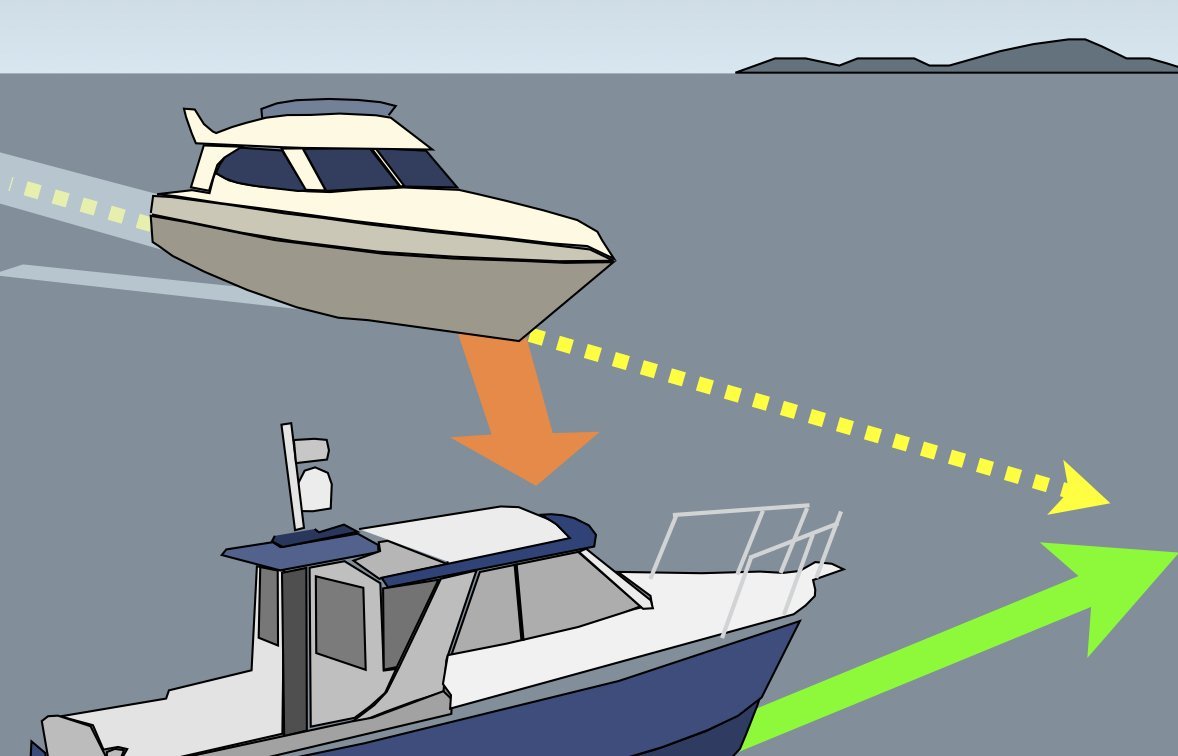
If two power boats are heading towards each other, both boats should alter course to starboard, so their port sides will pass each other.

If two power boats are crossing paths and there is a risk of collision, then the vessel which has the other on its starboard side must give way.  It must also avoid crossing ahead of the stand-on boat.

Narrow channels

All boats should keep to the right of narrow channels. Vessels of less than 20 metres in length and sailing vessels must stay clear of larger vessels who can only navigate within the channel.  It is often the case that smaller craft can operate safely outside a buoyed channel.

Give-way vessel

When two similar vessels are crossing, the one that has the other to its starboard side is the give-way vessel.

The ‘give-way’ boat is responsible for keeping clear and altering course where necessary to avoid a collision. The give-way boat should make an obvious course direction in plenty of time, so the stand-on vessel is in no doubt it has taken avoiding action.

Stand-on vessel

If you have the right of way you are the stand-on boat, keep to your course and speed to make it easier for the give-way boat to manoeuvre out of your way. If the give-way vessel does not take avoiding action, the stand-on vessel must be ready to turn quickly out of the way or stop as a last resort.

Overtaking

All vessels, whatever their size and type, must keep well clear of others when overtaking.

A vessel is said to be overtaking another if it is approaching more than 22.5º behind the other vessel’s beam.  This overtaking sector covers an arc of 135º, which is the same as the arc of a stern light.  At night, it is easy to tell if you are overtaking a vessel because you can see its stern light as you approach it. 

During the day, it is not always as easy to be sure you are in the overtaking sector.  Are you overtaking or alternatively are you crossing the other vessel’s path, in which case you could have right of way? If in doubt, it is always best to proceed with caution and keep well clear of the other vessel. 

Learn all of the nautical ColRegs Rules of the Road for power boating and sailing, in our comprehensive reference app, which includes a quiz to test yourself!

Stress cracks on GRP boats

It is quite common to find cracks in the gelcoat when inspecting the deck and superstructure of a GRP boat. It is important to differentiate between a gelcoat crack and a scratch.

Essential Knots: Clove hitch

Essential Knots: Clove hitch Use: Tying a rope to posts, bollards, rings or a guardrail. Step 1. Make a turn around the object and lay...

How to read nautical charts

Whilst most sailors today rely on GPS to find their way at sea, nautical charts are a crucial tool for any sailor to navigate safely and effectively. Here is a reminder of some of the basic steps involved in reading a nautical chart:

ColRegs Nav Lights & Shapes, Rules Of The Road and IALA Buoys Apps

ColRegs Nav Lights & Shapes, Rules Of The Road and IALA Buoys Apps Make Learning Rules on iPhone, iPad, iPod and Android...

Points of Sailing

The course on which a boat is sailing can be described by its angle to the wind, not to be confused with its compass...

Tacking a sailing boat

Tacking is the sailing manoeuvre used to change a boat's direction through an oncoming wind. Tacking a sailing boat calls for the crew to work as a...

Navigating narrow channels

Navigating narrow channels can present challenges for boat operators due to limited space, restricted manoeuvrability, and potential hazards such as shallows, rocks, or other vessels. To ensure safe passage through narrow channels, it’s essential to follow specific strategies and techniques.

Boat gas system maintenance

There are correct types of hose for marine plumbing, sewerage, exhaust, cooling and gas and all hoses should be checked regularly for wear and deterioration.

Antifouling for leisure boats – Part 4

Applying antifouling. Antifouling is best applied on a dry, calm day. It is best to apply the antifouling in the middle of the day to ensure the hull is dry and as warm as possible.

Learn ColRegs: Traffic Separation Schemes

Learn ColRegs Rule 10: Traffic Separation Schemes. (c) A vessel shall, so far as practicable, avoid crossing traffic lanes...

Saildrive maintenance

There are less maintenance tasks to carry out on a saildrive transmission than on a traditional inboard shaft drive system with its associated stern gear. However, there are a few critical things that require maintenance, as recommended in detail by the engine manufacturers, and should be adhered to.

Sail care and maintenance – Part 2

At the end of the sailing season sails should be washed and inspected carefully for damage, including small tears, stitching failure, ultraviolet damage, stains and mildew.

Jester Challenge 2022 – Sailing single handed from Plymouth UK to the Azores: Part 6 – Communications

Jester Challenge – A modern experiment in old-fashioned self-reliance, self sufficiency, and personal responsibility. This is the sixth of a 10-part post where solo sailor, Bernie Branfield, shares his first-hand account of his single-handed, 2022 Jester Challenge, from Plymouth, UK to the Azores, in his 26′ Invicta Mk2, Louisa.

How to operate a winch

Winches are drum shaped mechanical devices used to handle halyards, sheets and control lines. One of the important crew...

Stern gear maintenance

The stern gear of a boat needs to be checked carefully when the boat is ashore as this is something that can only be done when it is out of the water. The same applies for any maintenance and repairs that may need doing, so it is best to check it all over as soon after an end of season lift out as possible.

Boat surveys

A full boat survey assesses the condition of the hull, mechanical gear and means of propulsion. The survey is carried out with the boat...

An explanation of the IALA maritime buoyage systems – IALA A and IALA B

What are the differences between the two IALA buoyage systems, IALA Region A and IALA Region B, and where are they used?   As recently as the 1970s...

Understanding boat engines

Irrespective of what kind of engine a boat is equipped with and who does the work, the regular care and maintenance of a marine engine is essential. The most common cause of marine engine failure is widely known to be lack of maintenance.

Boat ownership – some fundamentals

Owning a boat is a big commitment that should bring no end of satisfaction, but the costs of maintaining and keeping a boat are significant and should never be underestimated.

Sailing Boat Rig Care

The rig of a sailing boat is put under huge stresses and strains so it is important for inspections of a yacht’s spars and rigging to be carried out at regular intervals.

Common marine electrical problems

Most problems with marine electrical systems arise from four possible sources, a lack of maintenance, a poor standard of initial installation, insufficient battery capacity, or ineffective charging systems.
Water ingress is a frequent issue – salt water can corrode contacts very quickly. If connections are not scrupulously clean – or are loose – resistance will be increased, resulting in progressively reduced power.

Engine failure at sea – common causes and how to avoid them

Many engine failures are caused by lack of maintenance, resulting in fuel filter blockages, water pump failures, overheating and other breakdowns. Indeed, one of the most common reasons for marine rescue service call outs is for one of the most basic reasons possible – boats that have run out of fuel.

Narrowboating on the Kennet and Avon Canal

A recently cancelled sailing event I was due to take part in left us with a free weekend in the diary. Given that my wife and I were celebrating a bumper wedding anniversary and the weather forecast was for fine weather, we decided to hunt around for a last minute canal holiday.

Boat engine cooling systems

Some boat engine breakdowns are unavoidable but those caused by lack of maintenance or regular checks can be avoided. Failure to maintain an engine’s cooling system is a well known example of this, so it is well worth spending time checking over the cooling system both when the boat is ashore and afloat.

Distress flares – which flare, how & when to use?

How to use distress flares at sea To effectively use distress flares at sea, you need to understand the different types, their purpose, and the...