
Select Page

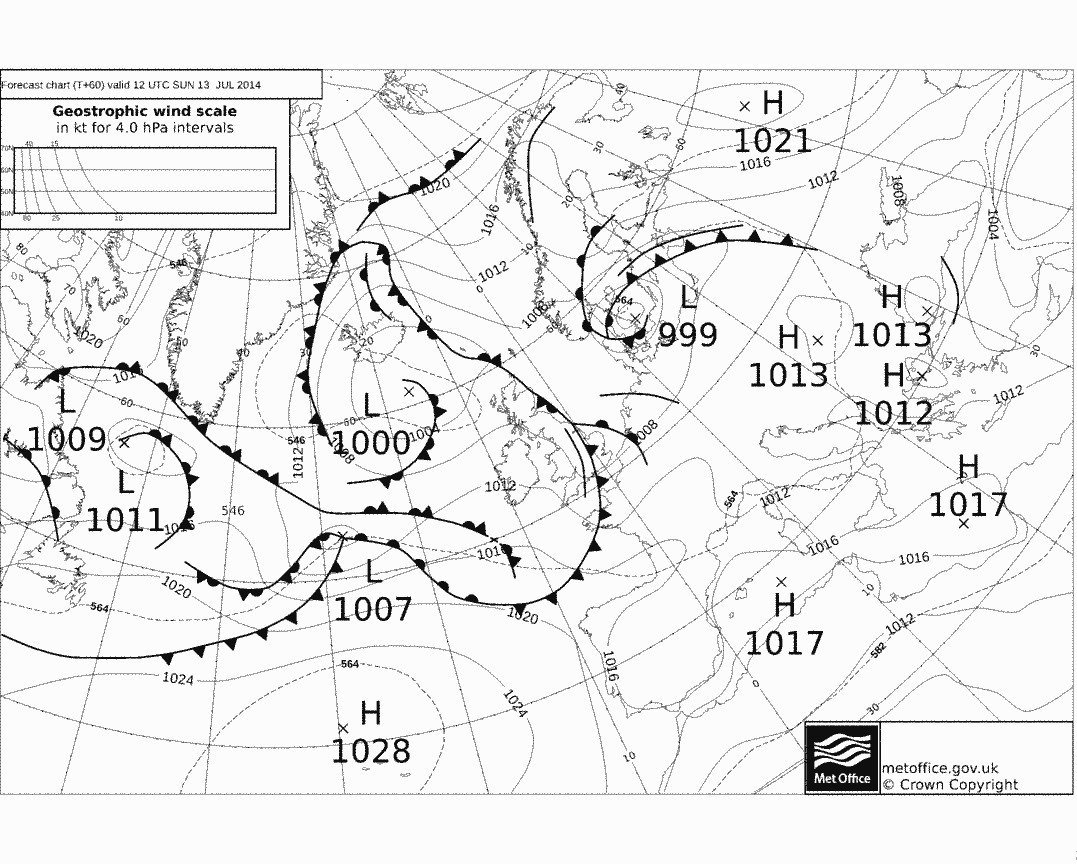
Weather charts, also known as surface pressure or synoptic charts, contain a lot of information that helps weather forecasters make predictions about the weather and sea conditions.
038_Met 5

Before going to sea it is always a good idea to study weather charts and work out how the weather is likely to evolve in the area you plan to sail in. This sequence of four synoptic charts predicts the weather over a 36 hour period.

038_Met 4

Isobars on a weather chart

The circular lines are isobars, similar to contour lines on a land map, and join areas of equal barometric pressure.  Air moves from high to low pressure and when the difference in the pressure is greater, the airflow or wind will also be greater.  Isobars that are close together indicate stronger winds. Isobars that are further apart indicate lighter winds. The wind scale inset in the top left of the chart helps you to forecast wind speed.

038_Met 3

Wind direction

In terms of the wind direction, in the northern hemisphere air moves around high pressure in a clockwise direction and low pressure in an anticlockwise direction, so isobars on a weather map indicate the direction and speed of the wind as well as the pressure.

038_Met 2

Fronts

The lines with triangles and semi-circles represent fronts. Warm fronts on a weather map are shown with semi-circles and cold fronts with triangles. The way in which the semi-circles and triangles point shows the direction in which the front is moving.

Occluded fronts and troughs

Where a cold front and warm front meet an occluded front is created, shown by lines with overlapping semi-circles and triangles.  Black lines with no semi-circles or triangles are troughs and show areas where the air is unstable and showers tend to form.

It is a good idea to print out the latest weather charts for your area before you set sail and refer to them on your trip.

Know your Navlights & Shapes – essential for all skippers

Know your Navlights & Shapes International Regulations for Preventing Collisions at Sea (ColRegs) Anyone who is...

Is Boating Good for Your Health and Happiness?

Absolutely! Boating offers a wealth of benefits for both your physical and mental well-being, making it a fantastic activity for overall health and...

Right boat vs Wrong boat – Over 30 Ways to Cut the Cost of Your Sailing and Cruising

Sailing and cruising offer unparalleled freedom and adventure, but they can quickly become costly. Fortunately, there are numerous strategies to help you enjoy the open water without breaking the bank. Here are over 30 practical ways to cut your sailing and cruising costs.

Cleaning & polishing painted topsides

The gelcoat topsides of a GRP boat can be pampered and restored to their former glory relatively easily when it is ashore. Gelcoat is only a very thin outer layer of the hull, often less than 1mm thick, so you should avoid cleaning it with highly abrasive cleaners, or an-ything that could potentially damage its surface.

Learning about diesel engine maintenance

Marine diesel engines are internal combustion engines that are designed specifically for use in maritime applications. These engines are commonly used in a variety of watercraft, ranging from small boats and yachts to large ships and vessels. Learn about marine diesel engine maintenance courses.

Pre-start engine checks

According to the Royal National Lifeboat Institution (RNLI) almost one third of emergency call outs at sea are caused by mechanical failure. Many engine breakdowns are avoidable. The best way to avoid a breakdown is to carry out pre-start checks before heading out to sea.

Understanding tides

If you are used to sailing in tidal waters, you will know that tides can be both a benefit and a hindrance to the sailor. In many ways,...

Cleaning & polishing gelcoat topsides

The gelcoat topsides of a GRP boat can be pampered and restored to their former glory relatively easily when it is ashore. Gelcoat is only a very thin outer layer of the hull, often less than 1mm thick, so you should avoid cleaning it with highly abrasive cleaners, or an-ything that could potentially damage its surface.

Navigating Through Rough Waters: Tips for Handling Adverse Weather Conditions in a Sailboat

Navigating through rough waters in a sailboat requires skill, preparation, and a good understanding of both your vessel and the environment. Here are some tips for handling adverse weather conditions including Preparation, Techniques, Safety and much more..

Saildrive maintenance

There are less maintenance tasks to carry out on a saildrive transmission than on a traditional inboard shaft drive system with its associated stern gear. However, there are a few critical things that require maintenance, as recommended in detail by the engine manufacturers, and should be adhered to.

Weather forecasting resources and tips

All competent sailors need to have a good basic understanding of how to interpret a weather forecast. They also need to be able to interpret the actual conditions they are experiencing.

Sailboat rig checks – Part 2

In part two of Sail boat rig checks we run through some useful rig maintenance tips and then finish with a brief look at what a professional rig check involves.

How to Avoid Collisions At Sea With The ColRegs

      Every Skipper Needs Accurate Knowledge of the IRPCS ColRegs As a responsible skipper it is every skipper’s duty to learn and apply the IRPCS...

Distress flares – which flare, how & when to use?

How to use distress flares at sea To effectively use distress flares at sea, you need to understand the different types, their purpose, and the...

Essential Yachting + Power Boat Safety Briefing

Yachting Safety Briefing   Down below Lifejackets and harnesses - fitting, when to wear, clipping on Gas - risks, precautions, gas bottles and...

Understanding your boat’s compass

Article submitted by Mike Rossiter, Certificated Compass Adjuster. Since the magnetic compass was first used by the Chinese...

Boat interior inspection and checks

While a boat is ashore, the most critical interior checks to carry out are those that concern the safety of the boat. This entails the integrity of all through-hull fittings and seacocks, the gas system and the electrical system.

Essential Knots: Figure of eight

Essential Knots: Figure of eight Use: Stopper knot, prevents a rope from being pulled through a hole e.g. through a block or...

Sterndrive maintenance

Sterndrives are a popular form of propulsion in the powerboat market, but require a fair amount of care and maintenance. The main factors to be aware of are salt water corrosion, lubrication and regular inspection of the bellows, the condition of which is vital to prevent water from entering into the hull.

Rewiring a boat – overcoming the challenges involved

Skippers need to have a basic knowledge of boat electrics, to avoid potential problems and to be able to solve them when they happen.

Essential Boat Spares for Safety

  Boats Spares Tool kit What you carry in the boats tool kit will be useful for many boat repairs, but you might want...

Essential Knots: Sheet bend

Essential Knots: Sheet bend Use: Joining two ropes together. A sheet bend is particularly useful for joining two ropes of different...

Understanding your mast and rigging

The rig of a sailing boat is put under huge stresses and strains so it is important for inspections of a yacht's spars and rigging to be...

Seasickness – how can you prevent it?

Seasickness is a common problem at sea and affects both seasoned sailors and novices. What are the causes and symptoms of seasickness?...

Estimating and plotting your position at sea

This post covers how we go about estimating and plotting our position using traditional methods, when out of sight of land – covering Dead Reckoning, Estimated Position, Tidal Streams, Leeway and more…