Select Page

Skilled boat handling is needed when entering or leaving harbour. Crew tasks include preparing the mooring lines and fenders before docking and tying the boat safely alongside. The crew also prepare the boat for leaving harbour. In order to help avoid any mishap, they have to release the lines in the correct order, as instructed by the skipper.

Arriving at a berth

The skipper will ask for the crew to prepare for berthing when a yacht enters harbour. The engine will be started if the yacht is under sail, the sails will be dropped and stowed, and the control lines coiled. 

Before approaching a berth, the skipper will ask the crew to get the mooring lines and fenders ready. The skipper will also give instructions where the lines and fenders should be attached.

Preparing the mooring lines

Mooring lines are attached to cleats at the bow and stern. Normally there are two lines prepared at the bow and two at the stern. Each line is fed beneath and back over the guardrail, then made ready to be taken ashore and tied to the dock. 
Fenders

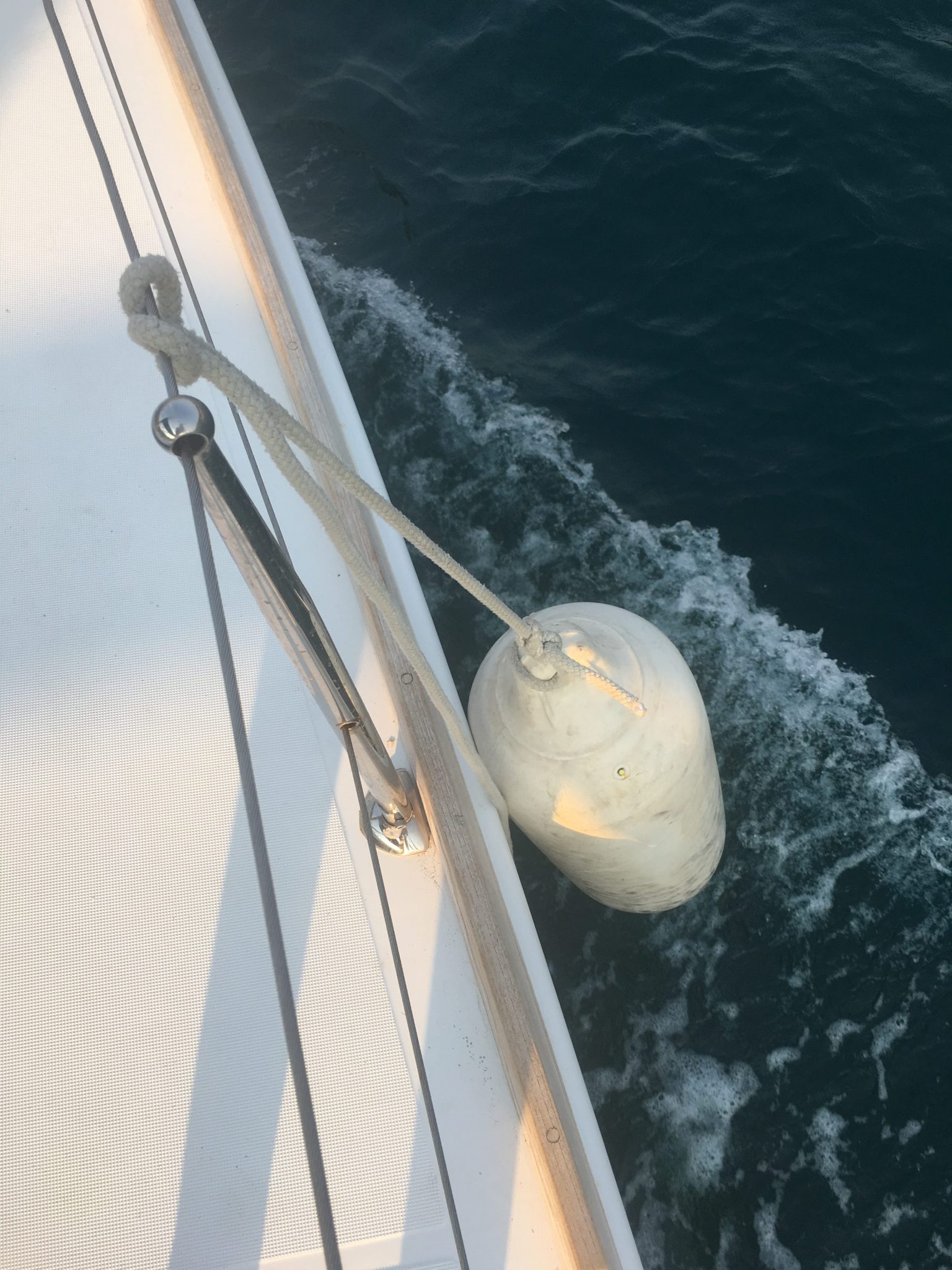
Fenders help prevent damage to a boat’s hull when it is alongside. A fender has a short rope which is attached to the guardrail using a clove hitch. A clove hitch is easily adjustable, therefore ideal for positioning the fender at the correct height to protect the hull. The fender needs to hang just above the water level so that it will protect the hull at its widest points when alongside.

Approaching the berth

When possible it is best for the boat to approach a berth into the wind, as this will help the boat to stop. If the wind is coming from behind, it will be more difficult to slow the boat down.

As well as taking the effects of the wind into account, in tidal waters the strength and direction of the tidal streams needs to be factored in. Given a choice, the skipper will most likely decide to approach the berth heading into the tide. If this is not possible, then bringing the boat to a stop becomes more difficult.

Stepping on to the pontoon

If you are responsible for a mooring line, hold it ready and move along the deck to the boat’s widest point before stepping ashore. Make sure the line remains outside the guardrail and side stays as you move along the deck to the centre position. Listen out for instructions from the skipper.

When the boat is alongside, step quickly ashore and secure the line to a cleat on the dock. If the line is a bow line, tie it to a cleat level or just forward of the bow. If the line is a stern line, then tie it level or just astern of the stern.

Tips for arrival:

  • Practice tying fenders to a guardrail using a clove hitch.
  • Practice tying a cleat hitch, round turn and two half hitches and bowline.
  • Make sure the mooring lines are not trailing through the water before docking.
  • Only step ashore when the skipper says it is safe to do so.

Leaving a berth

Before departure there is sometimes quite a bit of discussion about when it will be best to leave a berth, taking into consideration:

  • Tide – the direction of the tidal flow, whether it is rising or falling, is often critical for a safe departure from harbour.
  • Wind – is the wind blowing the boat towards the pontoon or away from it? This will affect the order in which the lines holding the boat alongside are cast off. 
  • Forecast – if a howling gale is forecast, it may be best to delay departure.

When it is time to leave, the crew will be asked to release the lines in the order the skipper asks. Under normal circumstances the spring lines will be released first. Then, either the bow or stern line are released, depending on the direction of the wind or tide.

Sometimes the direction of the wind and tide may make leaving difficult. In this case, extra lines and fenders may be needed to help manoeuvre away from the berth. The skipper will devise a plan and crew will be made responsible for various lines and await instructions.

Slipping a line

Before departure, some of the mooring lines may need to be re-tied, or set up, so they can be quickly released and pulled back on board immediately the skipper asks. This entails a crew member untying the line on the pontoon and arranging it in a long loop. Then, both ends of the line are fed back on board so that the line can be released from the boat. 

Tips for leaving:

  • Practice how to set up a line for slipping, making sure it doesn’t get caught as it is slipped.
  • Don’t untie or slip a line until the skipper has asked.
  • The first lines to be released will be those not taking any load.

Boat Security: Protecting your vessel from theft & vandalism

Boats are susceptible to theft and vandalism. Protecting your vessel from these risks requires a proactive approach to boat security. In this comprehensive guide, we’ll explore the various threats to boat security and provide practical strategies and technologies to safeguard your investment and enjoy peace of mind on the water.

How to read nautical charts

Whilst most sailors today rely on GPS to find their way at sea, nautical charts are a crucial tool for any sailor to navigate safely and effectively. Here is a reminder of some of the basic steps involved in reading a nautical chart:

Light characteristics – how do navigators identify lights at night?

How do navigators identify the different types of light around our coasts at night and what are their characteristics?Navigating at...

Antifouling for leisure boats – Part 1

Boats that are kept afloat can very quickly become a home for small marine organisms such as barnacles, weed and slime. Applying an antifouling paint to your hull is necessary to protect it from these micro-organisms, as a fouled hull can cause problems and will slow down a boat’s maximum speed considerably if left unchecked.

Points of Sailing

The course on which a boat is sailing can be described by its angle to the wind, not to be confused with its compass...

You Need To Understand The IRPCS ColRegs To Pass Your Yachtmaster, Master of Yachts and Coxswain Certificate of Competence

IRPCS ColRegs Rules of the Road at Sea and Yachtmaster Learning, understanding and remembering the International Regulations...

The Round The Island Race 2023

This year’s Round the Island Race turned out to be a really thrilling and competitive event. 1100 boats entered the race, which took place on Saturday 1st July. The race started from the world famous Royal Yacht Squadron line in Cowes UK, with the largest and fastest boats starting first, leaving the rest of us to wait our turn.

Common medical emergencies at sea

A medical emergency aboard a boat at sea requires immediate attention to ensure the safety of the casualty and the crew in general. The skipper needs to know which crew members, if any, have had medical training or have a first aid qualification. All boats should carry first aid handbooks to help an untrained crew cope with a medical emergency.

2023 Rolex Fastnet Race – Part 2

Simon Jollands took part in the 2023 Rolex Fastnet Race. This is the second of his articles on the race aboard Lancelot II, a Beneteau First 40.

Jester Challenge 2022 – Sailing single handed from Plymouth UK to the Azores: Part 6 – Communications

Jester Challenge – A modern experiment in old-fashioned self-reliance, self sufficiency, and personal responsibility. This is the sixth of a 10-part post where solo sailor, Bernie Branfield, shares his first-hand account of his single-handed, 2022 Jester Challenge, from Plymouth, UK to the Azores, in his 26′ Invicta Mk2, Louisa.

Understanding tides

If you are used to sailing in tidal waters, you will know that tides can be both a benefit and a hindrance to the sailor. In many ways,...

Sail trimming for cruisers

Sail trimming tips for cruisers. Whether racing or cruising, a well tuned boat will sail faster and tend to heel less than a boat with badly adjusted sails.

Boat engine fuel system

If engines are installed and serviced correctly then most marine engines are very reliable, but one of the most important parts of the engine to check and service is the fuel system.

Steel hull maintenance

A steel boat owner’s biggest enemy is corrosion. You don’t have to worry about osmosis or rotting timbers, instead rust is the number one issue that will keep you awake at night.

ColRegs when sailing single handed

  Don’t neglect the Colregs when sailing single handed Sailing single-handed represents several challenges for skippers, not least how to...

Essential Boat Safety Briefing

Skippers Responsibilities Skippers are obliged to give a safety briefing to the crew even if they are a regular crew. At...

Boat maintenance log

Keeping a boat maintenance log is an ideal way of reminding owners what needs to be done to a boat and when. Read on for some tips,...

Passage planning and pilotage

Passage planning and pilotage help skippers navigate safely from one port to another. A passage plan takes into account all...

Sail care and maintenance – Part 2

At the end of the sailing season sails should be washed and inspected carefully for damage, including small tears, stitching failure, ultraviolet damage, stains and mildew.

Boating Etiquette: Do’s and Don’ts on the Water

Boating etiquette is essential for ensuring the safety, enjoyment, and harmony of everyone on the water. Whether you’re a seasoned boater or new to the boating community, it’s important to be aware of the do’s and don’ts of boating etiquette. Take a look at our guidelines:

Rig check – how to prevent failure at sea

Regular rig checks prevent the risk of mast and rigging failure at sea. This includes regular rig inspections of the spars, ...

Common marine electrical problems

Most problems with marine electrical systems arise from four possible sources, a lack of maintenance, a poor standard of initial installation, insufficient battery capacity, or ineffective charging systems.
Water ingress is a frequent issue – salt water can corrode contacts very quickly. If connections are not scrupulously clean – or are loose – resistance will be increased, resulting in progressively reduced power.

Boating emergency – how to broadcast a MAYDAY emergency call

How to broadcast a MAYDAY emergency call   How to broadcast a MAYDAY emergency call if a vessel or person is in grave...

Top 5 Reasons Why an Inflatable SUP Should Be Your Next Yacht Accessory

In this article, inflatable paddle board expert Jason Paul gives the top 5 reasons why an inflatable SUP should be your next...

Nautical paper charts – a reminder of the basics

The nautical chart is an indispensable tool for navigation. A chart is a graphic representation of an area of the sea which might also include coastlines, estuaries and islands. All cruising leisure boats should carry up-to-date paper charts.