Select Page

What are the differences between the two IALA buoyage systems, IALA Region A and IALA Region B, and where are they used?
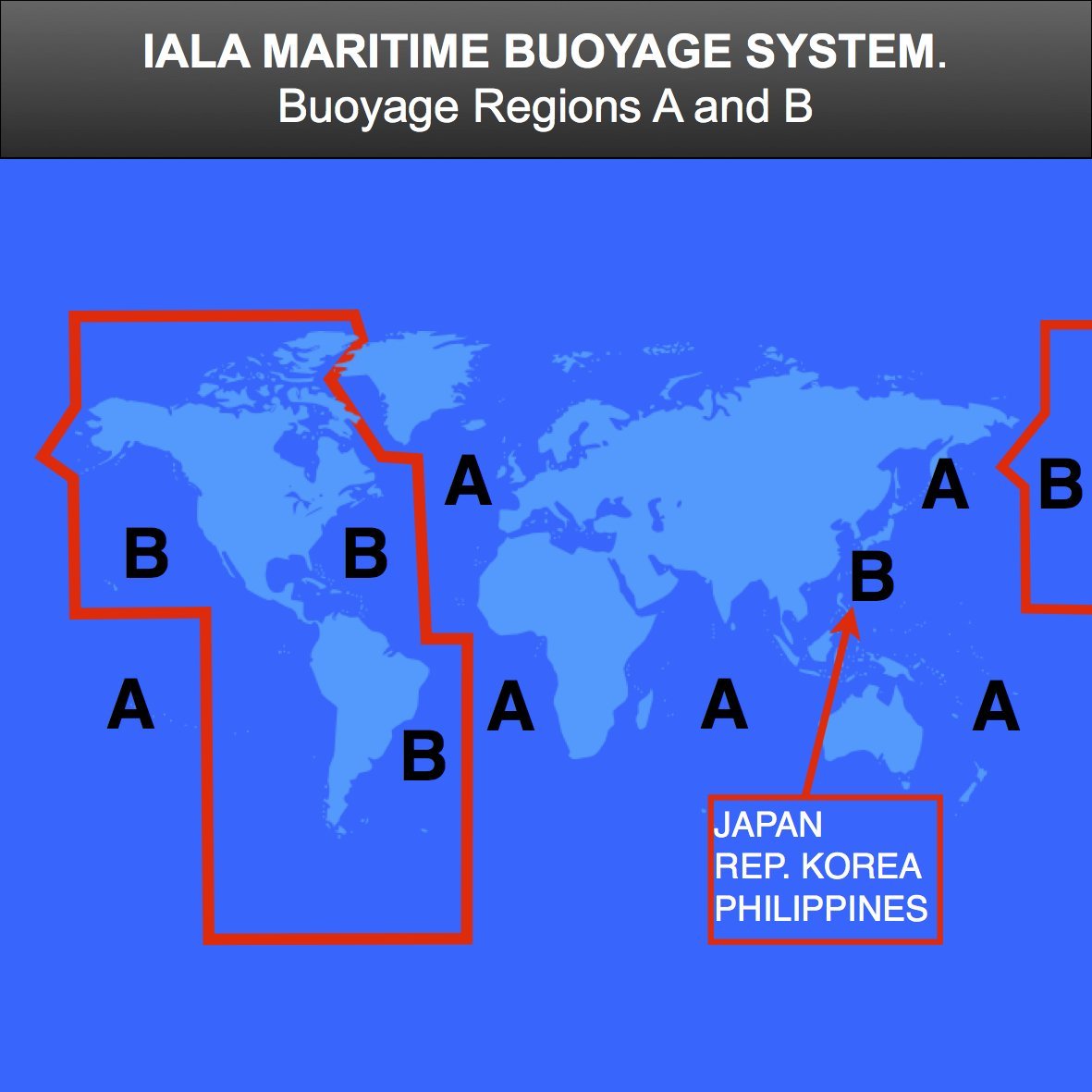
 IALA buoyage map

As recently as the 1970s there were more than 30 buoyage systems in use around the world. This caused confusion and accidents and it was after two fatal incidents in the Dover Straits in 1971 that the IALA (International Association of Marine Aids to Navigation and Lighthouse Authorities) was established.  There followed a worldwide effort to develop a safe, unified maritime buoyage system that could be followed by all vessels at sea.

This resulted in the IALA Maritime Buoyage System and by 1980 there were just 2 systems in use, IALA A and IALA B. Although there is not as yet one unified system for the whole world, this was a major achievement nonetheless and the differences between IALA A and IALA B are only minor. The IALA chose the two systems in order to keep the number of changes to existing systems to a minimum and to avoid major conflict.

IALA REGION A

IALA A is used by countries in Africa, most of Asia, Australia, Europe and India.

IALA REGION B

IALA B is used by countries in North, Central and South America, Japan, Korea and the Philippines.

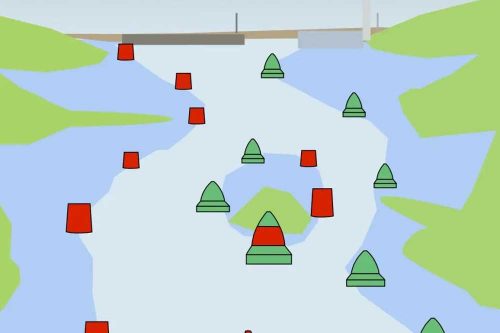
IALA A buoyage

IALA B buoyage

Take our IALA Buoys & Lights Quiz right now to see how much you know! Just click here.

The differences – lateral marks

The difference between the two systems is the colour and light characteristics used for lateral marks, as follows:

•  IALA REGION A port lateral marks and lights are coloured red.  IALA  A starboard lateral marks and lights are coloured green.

•  IALA REGION B port lateral marks and lights are coloured green.  IALA B starboard lateral marks and lights are coloured red.

Lateral marks indicate the port and starboard sides of navigable channels. These are used in accordance with the direction of buoyage for the region or specific location, as indicated on marine charts. Where a channel divides a modified or “preferred” channel mark may be used to indicate the preferred route to take.  In IALA Region A the lateral marks on the starboard side of the channel are coloured green and should be passed on the starboard side of the vessel. Those on the port side of the channel should be passed on the port side of the vessel.  In IALA Region B the lateral marks on the starboard side of a channel are coloured red and on the port side are coloured green.

The similarities – all other types of buoy

Aside from the different lateral marks, both systems use identical cardinal, isolated danger, safe water and special marks. In 2006 new danger marks were introduced, see details below.

Cardinal Marks

Cardinal marks warn of hazards to be avoided such as shallows or rocks. Their markings and shape indicate which side of a buoy a vessel should pass and are placed either to the north, south, east or west of a hazard. Therefore a vessel should pass to the west of a west cardinal mark, or to the east of a east cardinal mark and so on.  They are painted in combinations of yellow and black and have two distinct cone shapes on top, arranged in different combinations to help identify them.

Isolated Danger Marks

Isolated danger marks are used to indicate a single hazard, such as a wreck, which has navigable water all around it.  Vessels should keep well clear of the mark on all sides. They are coloured black with red bands and have two black balls above each other on the top of the mark.

Safe Water Marks

Safe water marks indicate there is safe water all around the mark. They are used at the start of a buoyed channel when approaching a harbour from the sea. They coloured with red and white vertical stripes.

Special Marks

Special marks are not intended primarily as navigation marks.  They are used to mark the boundaries of areas used for recreation eg water skiing or bathing, as racing marks and also for naval activities such as gunnery ranges.  Special marks are coloured yellow and can be a variety of shapes.

New Danger Marks

New danger marks were introduced in 2006 and are used as emergency marks for recent wrecks or new hazards which do not appear on nautical charts.  They are coloured with blue and yellow vertical stripes.

___________________

Safe Skipper apps have recently updated our Buoys and Lights app, which includes a full illustrated guide and a very useful test yourself section – see here.

Or – take our IALA Buoys & Lights Quiz right now to see how much you know! Just click here.

Jester Challenge 2022 – Sailing single handed from Plymouth UK to the Azores: Part 3 – Preparations

Jester Challenge – A modern experiment in old-fashioned self-reliance, self sufficiency, and personal responsibility. This is the third of a 10-part post where solo sailor, Bernie Branfield, shares his first hand account of his single-handed, 2022 Jester Challenge, from Plymouth, UK to the Azores, in his 26′ Invicta Mk2, Louisa.

Stress cracks on GRP boats

It is quite common to find cracks in the gelcoat when inspecting the deck and superstructure of a GRP boat. It is important to differentiate between a gelcoat crack and a scratch.

Safety Briefings – leave nothing to chance

Before giving your crew a safety briefing, it is worth considering the specific circumstances of the planned trip, the...

A five day sailing cruise of the Solent, UK

Welcome to our virtual Solent sailing cruise – a five day sail in the south of England from Bosham Quay in Chichester...

Sailing at the touch of a button

Easier and more controlled sail handling can also be achieved by powering up a furling mast. I came across some interesting solutions at the Southampton Boat Show this week on the Selden Mast stand, where they were running demos of their E40i electric winch and SMF furling system.

Rig check – how to prevent failure at sea

Regular rig checks prevent the risk of mast and rigging failure at sea. This includes regular rig inspections of the spars, ...

Essential Knots: Reef knot

Essential Knots: Reef knot Use: Tying two ends of rope together, often used for tying up a bundle of loose sail around the boom. Step...

Understanding tides

If you are used to sailing in tidal waters, you will know that tides can be both a benefit and a hindrance to the sailor. In many ways,...

Understanding boat engines

Irrespective of what kind of engine a boat is equipped with and who does the work, the regular care and maintenance of a marine engine is essential. The most common cause of marine engine failure is widely known to be lack of maintenance.

Boat electrics

All boat owners should have a basic knowledge of electrics, both to avoid encountering electrical problems at sea and to stand a chance of solving them should they occur.

Essential Knots: Round turn and two half hitches

Essential Knots: Round turn and two half hitches Use: Tying a rope to a pole or a ring. Step 1. Pass the end around the object. Step 2....

Repairing chips and dings in gelcoat

The gelcoat topsides of a GRP boat can be pampered and restored to their former glory relatively easily when it is ashore. Gelcoat is only a very thin outer layer of the hull, often less than 1mm thick, so you should avoid cleaning it with highly abrasive cleaners, or an-ything that could potentially damage its surface.

Safety at sea principles

Safety at sea is not as simple as just spending money adding shiny new emergency equipment such as liferafts, danbuoys, distress flares, EPIRBs and so on.

Jester Challenge 2022 – Sailing single handed from Plymouth UK to the Azores: Getting to the Start

Jester Challenge – A modern experiment in old-fashioned self-reliance, self sufficiency, and personal responsibility. This is the start of a 10-part post where solo sailor, Bernie Branfield, shares his first hand account of his single-handed, 2022 Jester Challenge, from Plymouth, UK to the Azores, in his 26′ Invicta Mk2, Louisa.

The dangers of running aground in a motor boat

The peril of grounding a motor boat is not only an inconvenience; it can lead to substantial risks for both the vessel and its passengers. . In this article, we’ll explore the potential dangers of running aground and highlight the importance of proper navigation and preparedness to avoid these hazards!

Preparing for sailboat cruising

Preparing for a sailing trip entails a lot of planning. In this blog, we take a look at some of the many safety aspects that a skipper needs to consider before heading off on a cruise.

Sending distress signals

In an emergency situation at sea, it is a top priority is to know how to send and receive emergency radio calls and alert others of your predicament. Likewise, if you receive a distress signal, you must be ready to go to the help of others.

Tools and spares for your boat

Tools and Spares to take to sea!

You won’t regret taking a look at our essential tips and checklist to make sure you’re prepared for routine maintenance and those unexpected jobs that come up whilst you’re afloat!

Sail care and maintenance – Part 2

At the end of the sailing season sails should be washed and inspected carefully for damage, including small tears, stitching failure, ultraviolet damage, stains and mildew.

Distress flares – which flare, how & when to use?

How to use distress flares at sea To effectively use distress flares at sea, you need to understand the different types, their purpose, and the...

Sailing Boat Rig Care

The rig of a sailing boat is put under huge stresses and strains so it is important for inspections of a yacht’s spars and rigging to be carried out at regular intervals.

Right boat vs Wrong boat – Over 30 Ways to Cut the Cost of Your Sailing and Cruising

Sailing and cruising offer unparalleled freedom and adventure, but they can quickly become costly. Fortunately, there are numerous strategies to help you enjoy the open water without breaking the bank. Here are over 30 practical ways to cut your sailing and cruising costs.

Boating emergency – how to broadcast a MAYDAY emergency call

How to broadcast a MAYDAY emergency call   How to broadcast a MAYDAY emergency call if a vessel or person is in grave...

Boat maintenance below decks

While most interior maintenance work can be done when a boat is afloat, some jobs such as servicing the seacocks have to be done ashore. It makes sense to do any major interior repairs and improvements with the boat hauled out in the boatyard.

Fire prevention on boats

  Fire prevention on boats - common causes of fire: • Smoking below decks • Galley cookers • Build-up of butane or...