Select Page

Weather charts, also known as surface pressure or synoptic charts, contain a lot of information that helps weather forecasters make predictions about the weather and sea conditions.
038_Met 5

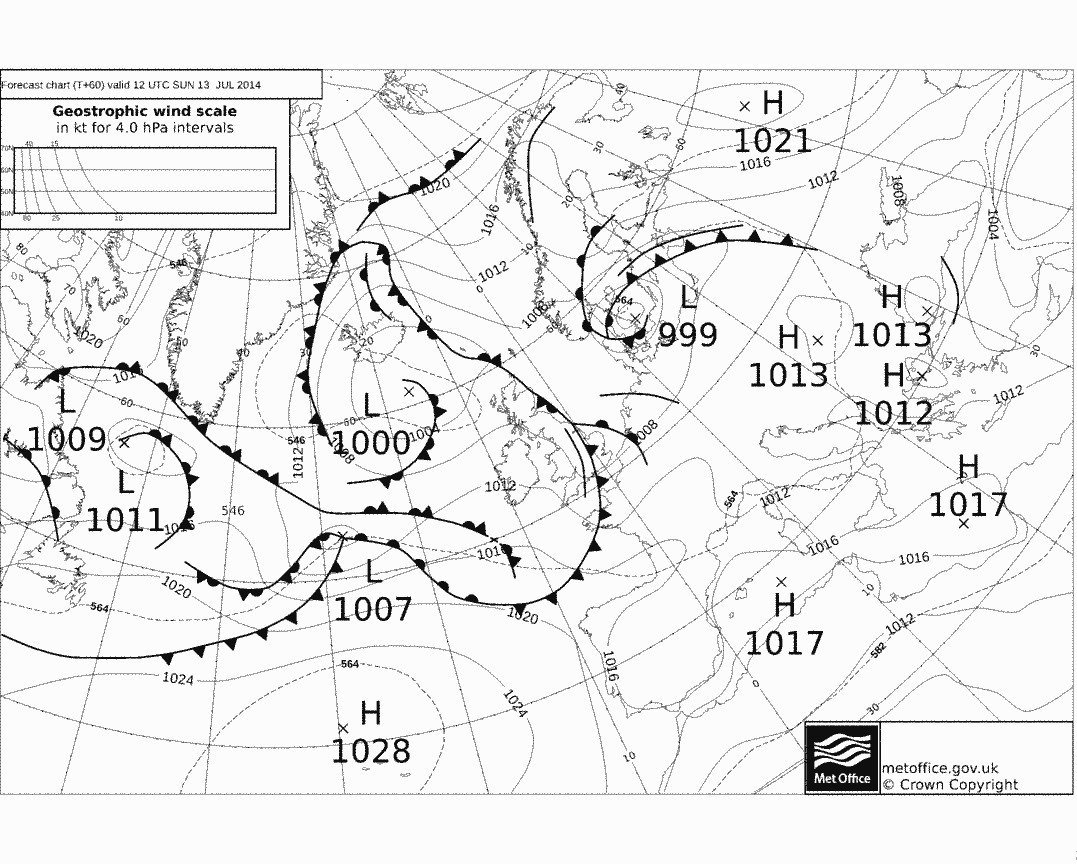
Before going to sea it is always a good idea to study weather charts and work out how the weather is likely to evolve in the area you plan to sail in. This sequence of four synoptic charts predicts the weather over a 36 hour period.

038_Met 4

Isobars on a weather chart

The circular lines are isobars, similar to contour lines on a land map, and join areas of equal barometric pressure.  Air moves from high to low pressure and when the difference in the pressure is greater, the airflow or wind will also be greater.  Isobars that are close together indicate stronger winds. Isobars that are further apart indicate lighter winds. The wind scale inset in the top left of the chart helps you to forecast wind speed.

038_Met 3

Wind direction

In terms of the wind direction, in the northern hemisphere air moves around high pressure in a clockwise direction and low pressure in an anticlockwise direction, so isobars on a weather map indicate the direction and speed of the wind as well as the pressure.

038_Met 2

Fronts

The lines with triangles and semi-circles represent fronts. Warm fronts on a weather map are shown with semi-circles and cold fronts with triangles. The way in which the semi-circles and triangles point shows the direction in which the front is moving.

Occluded fronts and troughs

Where a cold front and warm front meet an occluded front is created, shown by lines with overlapping semi-circles and triangles.  Black lines with no semi-circles or triangles are troughs and show areas where the air is unstable and showers tend to form.

It is a good idea to print out the latest weather charts for your area before you set sail and refer to them on your trip.

Boat maintenance log

Keeping a boat maintenance log is an ideal way of reminding owners what needs to be done to a boat and when. Read on for some tips,...

Jester Challenge 2022 – Sailing single handed from Plymouth UK to the Azores: Getting to the Start

Jester Challenge – A modern experiment in old-fashioned self-reliance, self sufficiency, and personal responsibility. This is the start of a 10-part post where solo sailor, Bernie Branfield, shares his first hand account of his single-handed, 2022 Jester Challenge, from Plymouth, UK to the Azores, in his 26′ Invicta Mk2, Louisa.

Safety at sea principles

Safety at sea is not as simple as just spending money adding shiny new emergency equipment such as liferafts, danbuoys, distress flares, EPIRBs and so on.

How to Avoid Collisions At Sea With The ColRegs

      Every Skipper Needs Accurate Knowledge of the IRPCS ColRegs As a responsible skipper it is every skipper’s duty to learn and apply the IRPCS...

Boat plumbing maintenance & troubleshooting

A boat’s fresh water system needs annual maintenance to keep it in good condition. Some boats have far more complex systems than others, with pressurised hot and cold water, associated pumps, an accumulator, calorifier and pressure valves, all to keep a boat owner busy.

Boat ownership

Owning a boat is a big commitment that should bring no end of satisfaction for the owner as well as the owner's family and friends. In...

Boat ownership – some fundamentals

Owning a boat is a big commitment that should bring no end of satisfaction, but the costs of maintaining and keeping a boat are significant and should never be underestimated.

Boat electrics inspection checklist

With the boat ashore, here are some recommendations for carrying out a boat owner electrics inspection. Safety is always paramount so remember to do the checks with the batteries off. Wearing a head torch helps, make notes as you go and only tackle a repair if you are 100% sure you know what you are doing:

Hull inspection – the annual checks

With the boat ashore for the winter it is time to do a hull inspection - the annual checks. Are there any scratches and chips in the...

Pleasure craft safety equipment recommendations

Safety equipment is an important part of boat preparation and it is advisable for all pleasure craft skippers to check their vessel is...

Boating Etiquette: Do’s and Don’ts on the Water

Boating etiquette is essential for ensuring the safety, enjoyment, and harmony of everyone on the water. Whether you’re a seasoned boater or new to the boating community, it’s important to be aware of the do’s and don’ts of boating etiquette. Take a look at our guidelines:

Top five windvane self steering installation questions

Top five windvane self steering installation questions answered by Sarah Curry of Hydrovane International Marine, courtesy of Viki Moore from Island Cruising NZ

Leaking decks

Leaking decks are perceived as a nuisance by some boat owners, but if leaks are ignored a much more serious situation may well be developing, especially in the case of boats with balsa or plywood deck cores. So deck leaks do need to be investigated and dealt with.

Boatyard Health and Safety

Boat storage facilities are potentially hazardous environments and it is the responsibility of both boat owners and boatyards to ensure that the...

First Aid Afloat – Jellyfish Stings

Jellyfish stings are a common occurrence when boating or swimming in many parts of the world. While most stings are not serious, some can cause...

Jester Challenge 2022 – Sailing single handed from Plymouth UK to the Azores: Part 2 – Weather

Jester Challenge – A modern experiment in old-fashioned self-reliance, self sufficiency, and personal responsibility. This is the second of a 10-part post where solo sailor, Bernie Branfield, shares his first hand account of his single-handed, 2022 Jester Challenge, from Plymouth, UK to the Azores, in his 26′ Invicta Mk2, Louisa.

Top 5 Reasons Why an Inflatable SUP Should Be Your Next Yacht Accessory

In this article, inflatable paddle board expert Jason Paul gives the top 5 reasons why an inflatable SUP should be your next...

Understanding your boat’s compass

Article submitted by Mike Rossiter, Certificated Compass Adjuster. Since the magnetic compass was first used by the Chinese...

How diesel engines work

The basic principle of a diesel engine is less complex than that of a petrol engine. No spark plug or ignition system is needed, making the basic diesel engine a comparatively straightforward system that results in fewer faults and has lower maintenance costs than a petrol engine.

ColRegs Nav Lights & Shapes, Rules Of The Road and IALA Buoys Apps

ColRegs Nav Lights & Shapes, Rules Of The Road and IALA Buoys Apps Make Learning Rules on iPhone, iPad, iPod and Android...

Antifouling for leisure boats – Part 3

Antifouling is one of the least pleasant boat maintenance jobs to do, but it has to be done. The very worst job of all is removing the old antifouling as this can get seriously messy and is very hard work.

Feeling anxious at sea

  Some people feel anxious at sea. Will they be seasick? What if they get caught in a violent storm? Could the boat...

Boat Handling – anchoring

Anchoring your yacht or motorboat Anchoring is one of the most important boat handling skills. If you can set an anchor...

Boat Engine Safety Checks

  Boat Engine Safety Checks Every skipper needs to make regular essential boat engine safety checks. Below you will...

Boat maintenance below decks

While most interior maintenance work can be done when a boat is afloat, some jobs such as servicing the seacocks have to be done ashore. It makes sense to do any major interior repairs and improvements with the boat hauled out in the boatyard.